Snow Removal in Wellesley, ON
Long rural laneways across the region's most open township, where drifting matters as much as snowfall.
Wellesley Township is the rural northwest of Waterloo Region, and for Kitchener Snow & Ice clearing snow here is a genuinely different trade from clearing it in Kitchener.
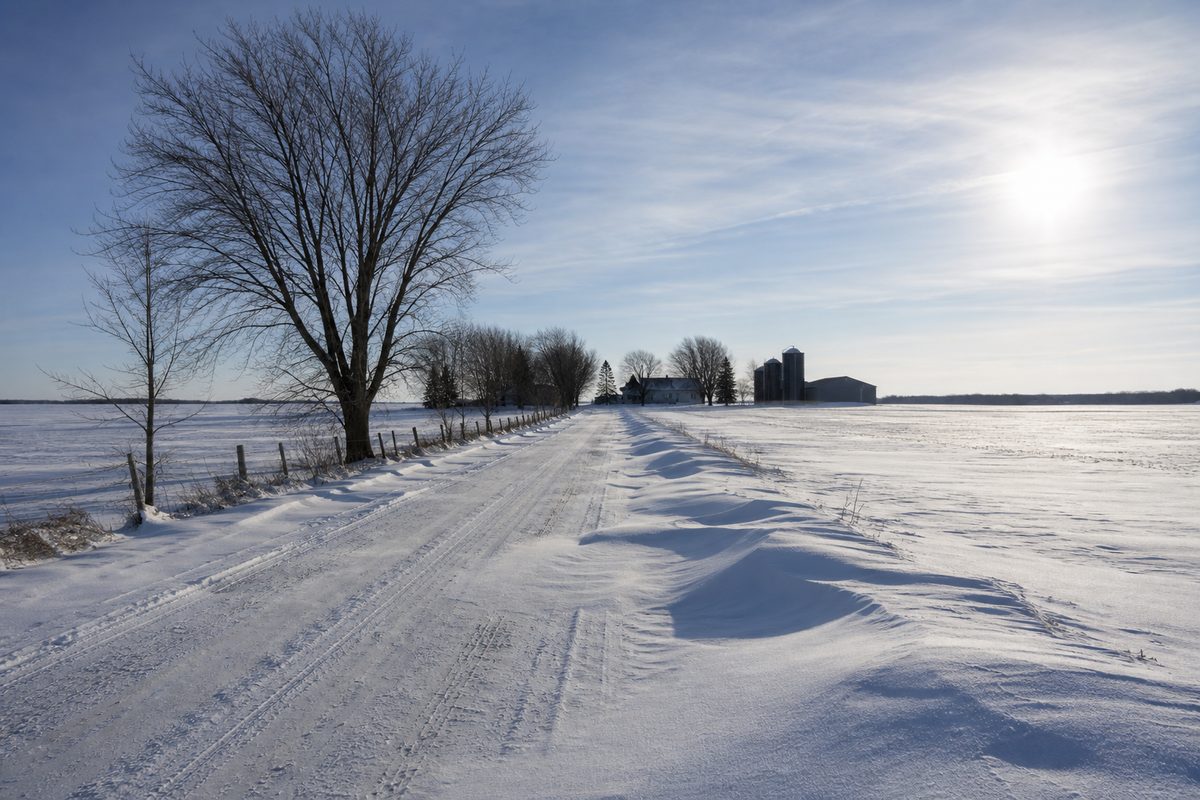
Open Country and Drifting
The township covers 277.76 square kilometres of rolling farmland, sugar maple woodland and concession roads, with roughly 220 kilometres of local road maintained by township public works under Ontario Minimum Maintenance Standards.
What matters for snow is how little of that is sheltered. Wind moving across open fields picks up loose snow and deposits it wherever something slows it down, which is usually a laneway, a hedgerow or the lee side of a building. A laneway cleared at midnight can be impassable by seven with no new snowfall at all.
That single fact is why rural service here is quoted differently. Drifting means a property can need attention when the forecast said nothing was coming, and any contractor telling you otherwise has not worked a laneway west of Waterloo in February.
Eight Communities, One Township
Wellesley Township takes in Wellesley village, St. Clements, Linwood, Hawkesville, Crosshill, Bamberg, Dorking and Kingwood. The 2021 census counted 11,318 residents across the township, growth of just 0.5 percent from 2016, making it the most stable and most rural part of the region.
The Conestogo and Nith rivers both run through or bound the township, and the Grand River Conservation Authority stocks trout in the Conestogo here and has been updating floodplain mapping on its lower reaches.
Sidewalks Are the Owner’s Job
Township by-law places sidewalk clearing on the property owner, within 24 hours of snowfall or freezing rain. That is worth stating plainly because North Dumfries, one township over, contracts sidewalk clearing municipally and its residents are not responsible in the same way.
On-street parking is prohibited from December 1 to March 31 between 4 a.m. and 9 a.m. without written township permission, and when a snow event is declared, which happens at an expected accumulation of 8 centimetres or more, parking on township highways is prohibited entirely. Declarations are issued by 5 p.m. to take effect at midnight.
Laneways Are Plow Work
Almost every rural property here is a blade job rather than a blower job. The volume is too high and the distances too long for anything else to keep up, and the snow needs pushing well clear so the next storm and the next drift have somewhere to go.
Neighbourhoods We Serve in Wellesley
- Wellesley village
- St. Clements
- Linwood
- Hawkesville
- Crosshill
Our Services in Wellesley
- Residential Snow Removal in Wellesley
- Driveway Snow Clearing in Wellesley
- Seasonal Snow Contracts in Wellesley
- Per-Visit Snow Removal in Wellesley
- Sidewalk & Walkway Clearing in Wellesley
- Ice Control & Salting in Wellesley
- Roof Snow & Ice Dam Removal in Wellesley
- Snow Removal for Seniors in Wellesley
- Emergency Snow Removal in Wellesley
- Snow Plowing in Wellesley
- Snow Hauling in Wellesley
- Snow Removal Cost in Wellesley
- Commercial Snow Removal in Wellesley
Snow Removal Questions in Wellesley
Why is drifting a bigger problem out here than in the city?
Open ground. Wellesley Township is the rural northwest corner of the region, 277 square kilometres of rolling farmland and concession roads with very little to break the wind. A laneway can be clear at midnight and blocked by morning with no new snow having fallen at all. That is drifting, and it is the reason a rural laneway sometimes needs a second visit when a city driveway does not.
Do you go out to all the villages?
The township covers eight communities including Wellesley village, St. Clements, Linwood, Hawkesville, Crosshill, Bamberg, Dorking and Kingwood. Routes are built geographically, so where we can reach depends on how the route fills. Booking before the season is the way to make sure you are on one.
How is a long laneway priced?
Separately from a city driveway, and by the specifics rather than by length alone. Travel time out from the built-up area, the run itself, where the snow can be pushed, and how exposed the laneway is to drifting all go into it. A few hundred feet of sheltered laneway and the same distance across an open field are different jobs.
Snow Removal in Wellesley
Driveways, walkways and ice control across Wellesley. Get a free written quote before the season starts.